"I want adventures in the great wide somewhere" Beauty and the Beast
Showing posts with label Conwy. Show all posts

Monday, 17 September 2018

UK Roadtrip Take Two - Conwy Castle, Erddig and Chirk Castle

17th September


This morning we were on the doorstep of Conwy Castle waiting for the doors to open so we could get inside and have a look, and honestly I'm glad we were.  By the time we left, 45 mins later, the previously empty car park was full, the people appearing and the clouds rolling in with the rain!


Conwy Castle (or in Welsh: Castell Conwy) a medieval fortification, was built for Edward I, during his conquest of Wales, between 1283 and 1289. The castle is amongst the finest surviving medieval fortifications in Britain. Constructed as part of a wider project to create the walled town of Conwy, an estimated £15,000 was spent building the castle, the largest sum Edward spent in such a short time on any of his Welsh castles between 1277 and 1307.


Over the next few centuries, the castle played an important part in several wars. It withstood the siege of Madog ap Llywelyn in the winter of 1294–95, acted as a temporary haven for Richard II in 1399 and was held for several months by forces loyal to Owain Glyndŵr in 1401. Following the outbreak of the English Civil War in 1642, the castle was held by forces loyal to Charles I, holding out until 1646 when it surrendered to the Parliamentary armies. In the aftermath the castle was partially slighted by Parliament to prevent it being used in any further revolt, and was finally completely ruined in 1665 when its remaining iron and lead was stripped and sold off. Conwy Castle became an attractive destination for painters in the late 18th and early 19th centuries. Visitor numbers grew and initial restoration work was carried out in the second half of the 19th century. In the 21st century the ruined castle is managed by Cadw as a tourist attraction.


UNESCO considers Conwy to be one of "the finest examples of late 13th century and early 14th century military architecture in Europe", and it is classed as a World Heritage site.The rectangular castle is built from local and imported stone and occupies a coastal ridge, originally overlooking an important crossing point over the River Conwy. Divided into an Inner and an Outer Ward, it is defended by eight large towers and two barbicans, with a postern gate leading down to the river, allowing the castle to be resupplied from the sea.


Conwy Castle was as beautiful inside as it was outside, maintaining its fairy tale image in our heads.  Though not so crash hot on the disability access (wet slippery stairs and ramps that were great fun with crutches), I managed to hobble around most of the castle itself, only having to avoid the wall walk along the tops of the wall themselves. 


After a trip around ASDA to buy sustenance for Rachael for her train trip (apparently trolley ladies like off Harry Potter don't actually frequent up and down real train aisles!), we deposited her safely at her train station, if a little early to catch her train back to London.  Rather 30 mins early than 2 mins late!


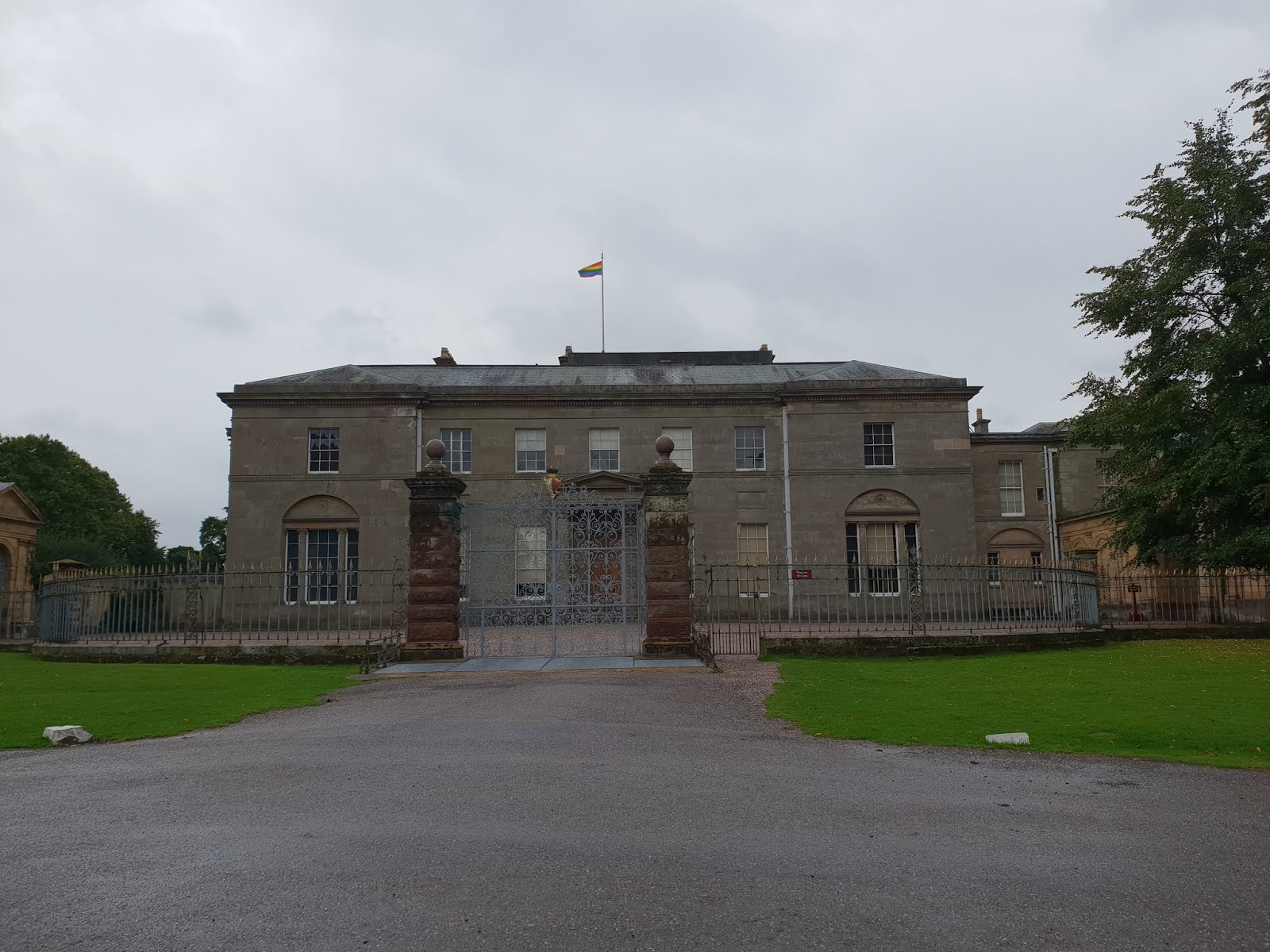
We then headed off back up the highway to Erddig,in Wrexham. After a brief exploration of the tour centre we headed 2 miles out to the National Trust property of Erddig Hall.  Erddid Hall was built in 1684–1687 for Josiah Edisbury, the High Sheriff of Denbighshire. Erddig is one of England's finest stately homes and is a Grade I listed building.


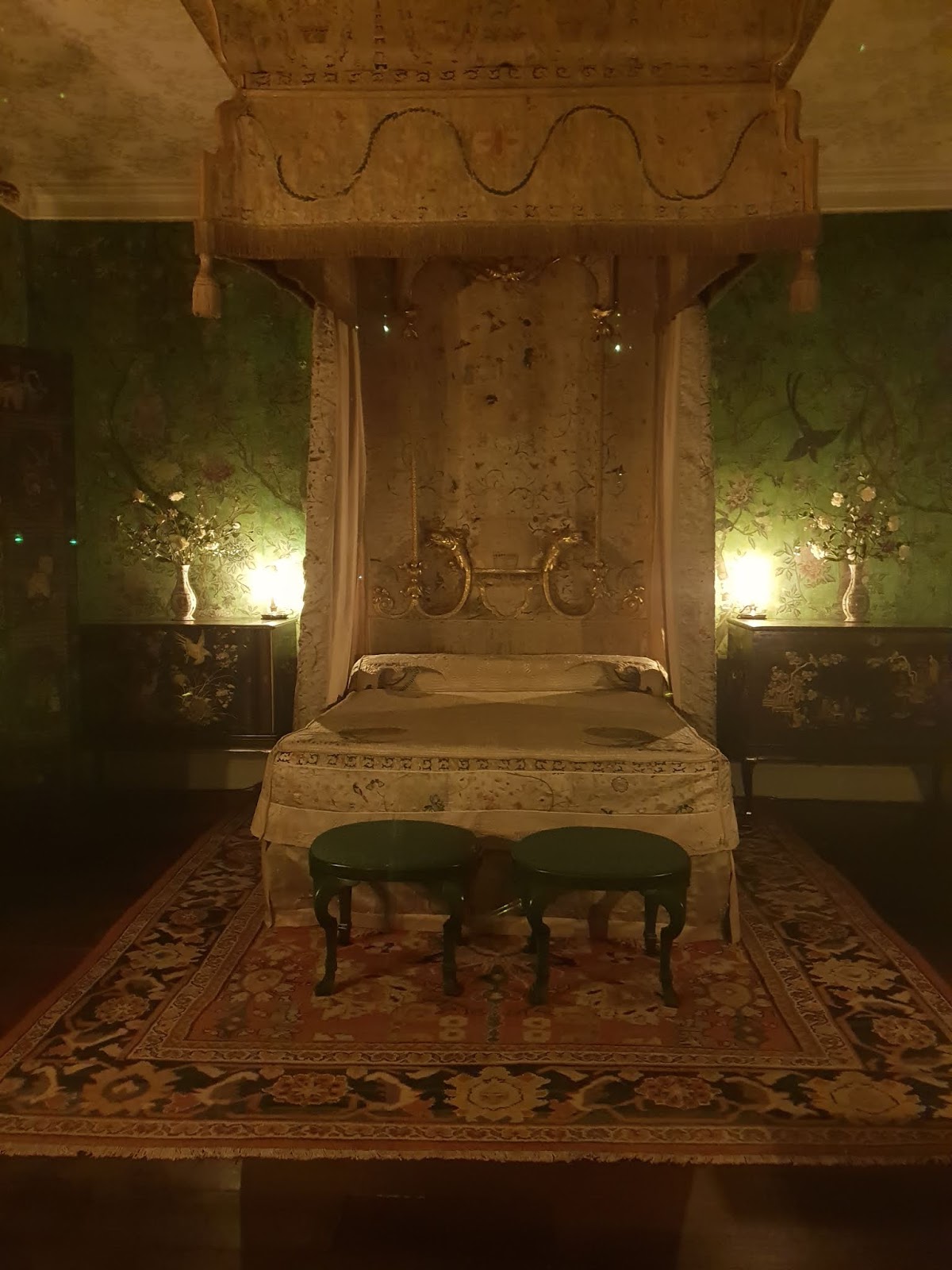
When visiting the house you are able to tour the grounds, house and gardens like most other stately homes around the country.  The difference in this home is the preserved distinction of the family and servants.  The tour starts "below stairs" and  tells of the Yorke family's unusually high regard for their servants and, through a collection of portraits, photographs and verses (a family tradition started by Simon's son Philip Yorke (1743–1804), who published The Royal Tribes of Wales in 1799), provides a record of the people who lived and worked on the estate. In the staterooms "above stairs" there is a fine collection of 18th century furniture and other treasures (many of which originally belonged to John Meller, including a portrait in the Music Room of Judge Jeffreys, the "Hanging Judge"). The Yorke family seemingly never threw anything away and the house now has a unique collection ranging from the rare and magnificent (including some exquisite Chinese wallpaper in the State Bedroom) to the ordinary and everyday. One of the conditions that the last Squire, Philip S. Yorke (1905–1978) imposed on handing over the house and estate to the National Trust in 1973 was that nothing was to be removed from the house, over 30,000 artifacts! He is quoted as saying: "My only interest for many years has been that this unique establishment for which my family have foregone many luxuries and comforts over seven generations should now be dedicated to the enjoyment of all those who may come here and see a part of our national heritage preserved for all foreseeable time."


We continued down the laneways to another National Trust property nearby, Chirk Castle. The castle was built in 1295 by Roger Mortimer de Chirk, uncle of Roger Mortimer, 1st Earl of March as part of King Edward I's chain of fortresses across the north of Wales. It guards the entrance to the Ceiriog Valley. The castle was purchased in 1595 for about 5,000 pounds by Sir Thomas Myddelton, a son of the governor of Denbigh Castle and successful London merchant. As a founder of the East India Company, an investor in the expeditions of Drake, Raleigh and Hawkins, he had the means to convert Chirk into a comfortable Tudor residence. His new stone north range contained a hall, buttery and kitchen, with upstairs drawing and dining rooms. This range, with alterations, became the main living quarters of the castle, while the old south range was gradually given over to servants. The castle was then passed down the Myddelton line (no relation to Kate Middleton unfortunately!). The castle passed into State care in 1978 and was handed to the National Trust in 1981.


On our way home we passed a beautiful castle ruin on the hill side, something you would never see in Australia!

 
Conwy Castle


Conwy Castle


Conwy Castle - from the cellar, if you imagine a ceiling over us that would have been the floor of the great hall.

Erddig Dining Room

 
The Chinese Wallpaper in Erddig, in a temperature controlled room


Erddig Hall


Chirk Castle

 
Chirk Castle Gardens and Dining room


Chirk Castle inner courtyard

Chirk Castle gates and gate house

Random ruins on the hill side!


Sunday, 16 September 2018

UK Roadtrip Take Two - Conwy and Colwyn Bay

15th September


After waking and getting ready this morning, which took longer than expected as our stuff was already all over the house, we headed off into Colwyn Bay for an explore and some shopping before collecting Rachael from the train.


I was thoroughly impressed with us when we were outside the train station at 12.04 ready to collect her, only for me to hobble inside and realize she wasn't there. A quick search on google offline maps, and we realized that we were at the wrong train station! Who names two train stations the same name!? So shortly later we arrived at the other train station in Llandudno, 15 mins down the road and collected a waiting Rachael. 


Once Rachael was safely on board we headed into Conwy to do some exploring through the town centre and have a spot of afternoon tea and cake.  We visited the water front and the smallest house in Britain.


That afternoon we headed out to Holywell to visit St Winifred's Well.  It was a decent drive down the main roads back the way we had come yesterday!


St Winefride's or Winifred's Well is a well located in Holywell, Flintshire, in Wales. It claims to be the oldest continually visited pilgrimage site in Great Britain, claiming pilgrimages begun in the 7th century, and is a grade I listed building. The healing waters of the well have been said to cause miraculous cures. The legend of Saint Winifred states that in AD 660, Caradoc, the son of a local prince, severed the head of the young Winifred after she spurned his advances. A spring rose from the ground at the spot where her head fell and she was later restored to life by her uncle, Saint Beuno. Richard I visited the site in 1189 to pray for the success of his crusade, and Henry V was said by Adam of Usk to have travelled there on foot from Shrewsbury in 1416.  In the late 15th century, Lady Margaret Beaufort had built a chapel overlooking the well, which now opens onto a pool where visitors may bathe.  James II is known to have visited the well with his wife Mary of Modena during 1686, after several failed attempts to produce an heir to the throne. Shortly after this visit, Mary became pregnant with a son, James.  With all of this history, there was nothing to do but stick my broken foot into the water and see if it works myself! After sitting my feet in the freezing water, I wasn't sure if my foot felt better because of the healing powers or because it was so cold I couldn't feel it anymore! We will have to wait until I return to Australia to have it re-x-rayed too see if its worked!
The coast line between Conwy and Colwyn Bay

The Smallest House in Great Britian
St Winifred's Well


UK Roadtrip Take Two - Manchester to Conwy

14th September

This morning was the last morning of Mum's conference, so we packed up our little house and loaded it all into the car before heading into Manchester and the Principal Hotel for the last time. Once there we set Nan up in the lobby with her book and we headed off to the final presentations.   Thoroughly interesting as they were, I was quite happy when they were finished and we could begin our road trip!

From Manchester we headed out down the M56 to Quarry Bank.  Quarry Bank Mill (also known as Styal Mill) is found in Styal, Cheshire.  It is one of the best preserved textile mills of the Industrial Revolution and is now a museum run by the National Trust UK of the cotton industry. Built in 1784, the mill is recorded in the National Heritage List for England as a designated Grade II* listed building.  At the site you are able to visit and explore the mill, visit the apprentice house and garden and Quarry Bank House as well as wander the extensive grounds. 

Most impacting was the guided tour of the apprentice house.  Here you get to see just what life was like for the children who lived there. Timed tickets for the tour are collected upon entering the grounds and we made our way straight to the Apprentice House. The early Industrial Revolution wasn’t just powered by water and steam. It was powered by children. At Quarry Bank, child workers lived in the Apprentice House where they were given food and board in exchange for their labour. Children as young as eight years old were brought from workhouses or from their family homes to the Apprentice House. As many as 90 children lived packed in together, and worked in the mill in exchange for food, clothes and board. On this tour, you can see where these children lived, ate and slept from the 1790s right through to the end of the apprentice system in the 1840s, and explore the garden that the children tended after their long shifts in the cotton mill. Compared to many apprentices in the cities, these children were given access to health care and physicians when required.  However the nineteenth century cures for everything from headaches to lost limbs that we leant about might not have been so helpful!

One of the current exhibitions at Quarry Bank is Lost Voices.  In 1918 women in Britain were finally given the right to vote, but only if they were over 30 and owned property. This meant that for the majority female workforce in the cotton mill at Quarry Bank, nothing changed. They didn't receive the vote for another 10 years. Lost Voices explores the experiences of women whose stories were not heard, and which are often lost to us today because of their age, status or means. Installations across Quarry Bank bring their voices to life.

After finishing up at Quarry Bank and catching the little golf cart back up the hill, we piled back into the car and headed down the road to Tatton Park.  Tatton Park is an historic estate, north of the town of Knutsford, Cheshire. It contains a mansion, Tatton Hall, a medieval manor house, Tatton Old Hall, Tatton Park Gardens, a working 1930's farm and a deer park of 2,000 acres (8.1 km2).  Tatton Hall, the mansion on the estate is the main area we walked through.  Around 1716 a new house was built on a separate site for the Egerton family. From 1758 improvements were made to the house and between the 1770s and 1816 most of it was replaced by the present neoclassical mansion, designed by Samuel Wyatt and his nephew Lewis William Wyatt. Further additions to the house were made in 1861–62 and in 1884. During the late 19th century large house parties were held in the hall, some of them attended by British and foreign royalty.  The mansion contains much of the furniture made for its occupants by the family firm Gillows of Lancaster.  Also in the hall is a large collection of paintings, many of them being portraits of the Egerton family, and in addition paintings by Canaletto, Poussin, Chardin, Van Dyck, Vasari, and many others. The Library contains first editions of two novels by Jane Austen. One room is dedicated to a collection of items from around the world assembled by the last owner of the house, Maurice Egerton. In the family wing are the servants' quarters. These include rooms containing much of the equipment and many of the utensils used to serve the family.

Our history quota filled for the day, we headed into Chester to do a bit of shopping through the main centre of town and grab some thing for dinner. We managed a flying visit through the Chester Cathedral before the priest (literally!) shut the doors behind us for the evening prayers. From here we jumped back into the car and made the journey to Conwy, North Wales where our next Air BnB apartment is.  After being extremely impressed with the Conwy Castle sights as you come over a bridge into Conwy, (it looks like something out of a fairy tale!) we found our apartment easily enough, although parking was a hassle!! Trying to park a large car on a tiny road with only street parking isn't so fun!!


The Apprentice House at Quarry Bank


The Deer at Tatton Park

Tatton Hall


Chester Cathedral


Chester Cathedral

Conwy Castle coming into Conwy